/thyssenkrupp_logo_claim_d.svg)
Report by the Supervisory Board
As a preface to my report about the work of the Supervisory Board and its committees in fiscal year 2024 / 2025, I would like to make a few general comments about the past fiscal year and the conditions faced by thyssenkrupp in Germany and around the world.
We are experiencing years of great turmoil and change in the geopolitical environment, which has greatly impacted the global economy. In Europe, the war in Ukraine has caused profound changes. Globally, this situation is aggravated by other military conflicts, terrorism, growing polarization and the use of international trade as a means of enforcing national interests. Taken together, they represent the framework for our activities as a company and for the German and European economies overall. No one is spared these effects and companies are repeatedly confronted with new and in part erratic political interventions and deadlines. If one thing has emerged as the new normal in recent years and in our current situation, it is the lack of stability and predictability of the framework conditions.
Against this backdrop, there has also been a change in the focus and priorities of the political, media and social agenda. Security, defense, access to raw materials and energy have moved to the forefront, while climate neutrality and environmental issues have become less important – at least for the moment. This has impacted thyssenkrupp’s businesses to varying degrees. On the one hand, the structural necessity for decarbonization, the associated need for investment and cost pressures remain strong because of political dictates and targets – for example, for the transformation of steel production. On the other hand, we are seeing a hesitancy in translating the fundamentally high level of interest among customers worldwide for our decarbonization solutions into increased demand. The situation is quite different for the construction of naval vessels by TKMS and in respect of the growing calls across the political spectrum to protect steel production in Germany and Europe from being squeezed out by competing imports. The prevailing global situation is shaped by strong geopolitical influences, providing both opportunities and disadvantages but no reliable overall picture.
In entrepreneurial terms, our task remains to develop and modify each of our businesses in such a way that they are or become viable and competitive on the basis of their own earnings power, without requiring cross-subsidization within the group. This is also the core element of the future concept for developing the group, which was first presented and explained to us by the Executive Board at our meeting in June, with additional details provided at subsequent meetings. The conditions for TKMS were already established by the decisions taken in the past fiscal year and this business became independent following its stock market listing in October 2025. The target for steel is clear and corresponding steps have been initiated. In the years ahead, the other segments will also be prepared for the capital market and then become independent. However, the paths to achieving this are variously long. Of course, this also means further changes to thyssenkrupp AG itself. It will become a financial holding company that holds investments in independent entities, coupled with a substantial further streamlining of its structures.
At the extraordinary meeting of the Supervisory Board on June 20, 2025, we extended the contract of Chief Executive Officer Miguel López. His previous contract expires on May 31, 2026; his new contract has a term of five years until May 31, 2031. Other changes on the Executive Board related to the Human Resources and Finance directorates. As a result of the strong growth in business at TKMS and its spin-off with a new ownership structure, as approved by the Extraordinary General Meeting on August 8, 2025, it has become necessary for Oliver Burkhard to concentrate fully on his duties as Chief Executive Officer of Marine Systems. He continues to serve the group in a very important role and this decision has the full support of the Supervisory Board. After 12 years as a member of the Executive Board of thyssenkrupp AG, he stepped down at the end of the Annual General Meeting on January 31, 2025. The Supervisory Board thanked him very warmly for his long years of service as Labor Director and CHRO. Dr. Jens Schulte also left the Executive Board as of May 31, 2025; he has joined the Executive Board of Deutsche Börse AG. The two Executive Board members who stepped down have been succeeded by Wilfried von Rath as the new CHRO and Labor Director as of April 1, 2025, and by Dr. Axel Hamann as of May 1, 2025. Dr. Axel Hamann assumed the position of CFO as of June 1, 2025.
In fiscal year 2024 / 2025 the Supervisory Board regularly advised the Executive Board on the management of the company and continuously supervised its conduct of business. We satisfied ourselves that the Executive Board’s work complied with all legal and regulatory requirements at all times. The Executive Board fulfilled its duty to inform. It furnished us with regular written and verbal reports containing up-to-date and comprehensive information on all issues of relevance to the company and the group relating to strategy, planning, business performance, the risk situation, compliance and the sustainability strategy. This also included information on variances between actual performance and previously reported targets as well as on budget variances (follow-up reporting). The Executive Board continued to report regularly on the development and implementation of sustainability topics. In the committees and in full Supervisory Board meetings, the members of the Supervisory Board had ample opportunity to critically examine the reports and resolution proposals submitted by the Executive Board and contribute suggestions. In particular, we discussed intensively and examined the plausibility of all transactions of importance to the company on the basis of written and verbal reports by the Executive Board. On several occasions, the Supervisory Board dealt at length with the company’s targets, the risk situation and cybersecurity, refinancing and liquidity planning and the equity situation. Based on the analysis of the value potential of the group’s businesses and the opportunities and risks of strategic steps, critical operating issues were presented to the Supervisory Board for discussion. Where required by law, the Articles of Association or the rules of procedure for the Executive Board, the Supervisory Board gives its approval for individual business transactions.
The Supervisory Board and Executive Board worked together intensively and shared information. At 12 meetings of the Executive Committee, the majority of which were attended by Executive Board members and occasionally by external advisors as well, all topics were discussed in detail and meetings of committees and the Supervisory Board were prepared and followed up.
In addition, in the periods between meetings, the chairs of the Supervisory Board and its committees engaged in a close and regular exchange of views and information with the Executive Board and were informed about major developments. Important facts were reported at the latest at the subsequent Supervisory Board or committee meetings. Before the Supervisory Board meetings, the shareholder and the employee representatives each held separate meetings to discuss the agenda items.
The Supervisory Board members are required by law and by the German Corporate Governance Code (GCGC) to immediately disclose any conflicts of interest. In the past fiscal year, there were no conflicts of interest relating to Executive Board or Supervisory Board members that would have had to be disclosed immediately to the Supervisory Board.
thyssenkrupp assists the members of the Supervisory Board in the organization of the training and professional development measures that the members themselves are generally responsible for undertaking in fulfillment of their duties and provides financial support by assuming the costs of such measures. To supplement this, the company offers information events and training sessions on specific topics. In fiscal year 2024 / 2025, the Supervisory Board concerned itself in depth with the Materials Services segment, supplemented by a tour of the Krefeld site. In addition, all members of the Supervisory Board were offered the opportunity to participate in thyssenkrupp e-learning modules on corruption prevention, compliance, antitrust law, data protection and artificial intelligence (AI). There is an established onboarding process to familiarize new Supervisory Board members with the thyssenkrupp business model, group structures and special topics. The Corporate Office acts as coordinator. In addition, it informs the members of the Supervisory Board about their rights and obligations, conducts individual discussions with them and ensures the provision of the necessary documents and authorizations for sharing information via digital channels.
Meetings of the Supervisory Board and its committees generally take the form of in-person attendance with the option of participation via a video link. Meetings are only held exclusively as telephone or video conferences in exceptional circumstances. In the reporting year, only five out of a total of 38 meetings of the Supervisory Board and its committees were held as video conferences; all others were in-person meetings.
The attendance rate at the meetings of the Supervisory Board and its committees was 99.6%. The following table shows attendance in individualized form: see table.
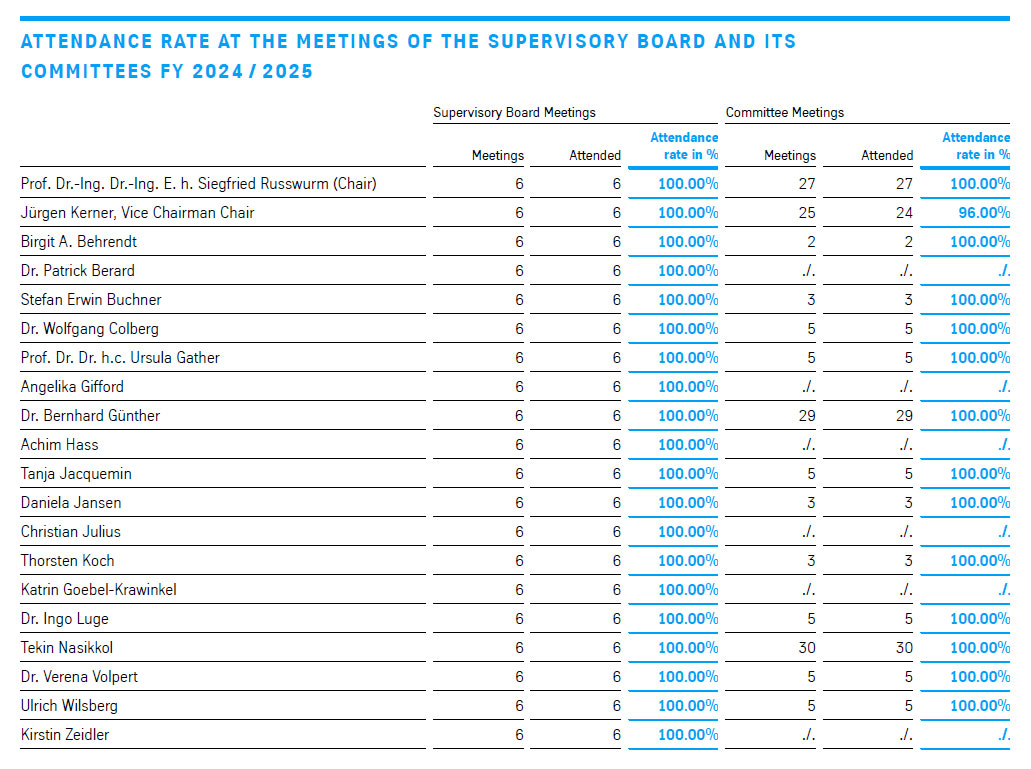
The members of the Executive Board took part in meetings of the Supervisory Board and its committees; however, the Supervisory Board also met regularly without the Executive Board.
In total, six Supervisory Board meetings were held in the reporting year. The range of topics that the Supervisory Board dealt with included the current business and earnings situation and the parent-company and consolidated financial statements for the year ended September 30, 2024. On the recommendation of the Audit Committee and after discussion with the auditors, KPMG Aktiengesellschaft Wirtschaftsprüfungsgesellschaft (KPMG), the Supervisory Board approved the parent-company and consolidated financial statements for fiscal year 2023 / 2024 and thus adopted the parent-company financial statements.
Further topics were corporate governance, compliance and the mandatory EMIR audit for 2024 pursuant to § 32 of the German Securities Trading Act (WpHG), as well as the regular updates on all segments.
The reports by the Executive Board on the state of the thyssenkrupp group and its ongoing development were supplemented by status updates on the value and development plans of the individual segments. This formed the basis for the continued intensive discussions on improving performance, portfolio measures and the short- and medium-term earnings targets for all segments. The Supervisory Board also discussed in detail and adopted the business and investment plans for fiscal year 2025 / 2026. The portfolio topics considered intensively included the plans to place the Steel Europe and Marine Systems segments on a stand-alone basis. In the case of Steel Europe, the progress in constructing the first direct reduction plant at the Duisburg site – a measure that is part of the green transformation – was a particular subject of detailed discussion.
In fiscal year 2024 / 2025, following examination of the recommendations and suggestions of the GCGC, the Supervisory Board adopted a resolution to issue the declaration of conformity. The current declaration of conformity, issued as of October 1, 2025, is available on the thyssenkrupp website. In addition, the Executive Board and Supervisory Board report on corporate governance at thyssenkrupp in the corporate governance statement.
The primary task of the Supervisory Board’s six committees is to prepare decisions and topics for discussion at the full meetings. The Supervisory Board has delegated individual decision-making powers to its committees where this is legally permissible. The powers of the committees and the requirements on committee members are set out in the rules of procedure for the respective committees. The chairs of the committees provided the Supervisory Board with regular detailed reports on the work of the committees in the reporting year. The chairs of the committees were also in close contact with the other members of their committees outside the regular meetings to exchange views on particularly important topics. The compositions of the six committees as of September 30, 2025, are shown in the section headed “Supervisory Board.”
The Executive Committee (Präsidium) met 12 times in the past fiscal year due to the current situation and the preparations for the seminal meetings of the Supervisory Board. In addition to preparing the full Supervisory Board meetings, the work of this committee focused on the financial position and earnings performance of the group and topics relating to the transformation of thyssenkrupp.
The Personnel Committee held nine meetings in fiscal year 2024 / 2025 in order to prepare personnel matters concerning members of the Executive Board of thyssenkrupp AG for the Supervisory Board. Where required, resolutions were passed or recommendations for resolutions were made to the Supervisory Board. Alongside the personnel change on the Executive Board, the meetings focused on decisions on aspects of compensation, especially setting the targets and determining the target achievement for variable compensation components and the disclosures in the compensation report pursuant to § 162 of the German Stock Corporation Act (AktG). The committee also dealt with general Executive Board matters, partly in connection with benefits for former Executive Board members.
The Audit Committee met five times in fiscal year 2024 / 2025. Alongside Executive Board members, following the election of KPMG as the auditor at the 2025 Annual General Meeting and its formal appointment by the Audit Committee, representatives of KPMG were present at the meetings. KPMG gave the Audit Committee a declaration that no circumstances exist that could lead to the assumption of prejudice by the auditors. The Audit Committee obtained the required auditors’ statement of independence and signed a fee agreement with the auditors. In addition, there was a discussion of the audit quality and of the auditors’ audit planning; the additional services provided by KPMG alongside the audit of the financial statements were also discussed by the Audit Committee.
Dr. Verena Volpert, Chair of the Audit Committee, engaged in a regular exchange of views with the auditors between meetings. The heads of relevant corporate functions were also available to provide reports and take questions in the committee meetings.
The committee’s work focused on examining the 2023 / 2024 parent-company and consolidated financial statements along with the combined management report including the non-financial statement and the combined corporate governance statement of the Executive Board and Supervisory Board, as well as on preparing the Supervisory Board resolutions on these items. In addition, the interim financial reports for fiscal year 2024 / 2025 (quarterly reports) were discussed in detail and adopted, taking into account the auditors’ review reports. With regard to the relationship with KPMG, the list of non-audit services provided by the statutory auditor that require approval was reviewed, the budget for the performance of non-audit services for fiscal year 2025 / 2026 was set, and the procedure and quality assurance for financial statement auditing was discussed.
In several meetings, the Audit Committee monitored the accounting process and discussed the effectiveness of the internal control system and optimizations made to it, as well as the effectiveness of the risk management system and the internal auditing system. It also dealt in detail with the main legal disputes and compliance in the company and discussed at length the development of strategic compliance measures at thyssenkrupp.
The Audit Committee defined the following mandate as the focus of the audit: “Audit support for the project to redesign the group management report.” The auditors reported the results of their audit to the Audit Committee at its meeting on December 5, 2025.
In addition, in the presence of the head of Corporate Internal Auditing, the committee discussed at length the audit results, audit processes and audit planning of the internal auditing team for fiscal year 2024 / 2025, including audit support for the investment in Steel Europe’s first direct reduction plant. Further points of focus were the non-financial statement, which is a separate part of the management report (sustainability report), the equity capital and liquidity situation, the EMIR compliance audit for fiscal year 2023 / 2024 pursuant to § 32 of the German Securities Trading Act (WpHG), the current performance of all segments, the report given at each meeting on the status of first-time sustainability reporting at thyssenkrupp in accordance with the CSRD for fiscal year 2024 / 2025 and the preparation of the closing financial statements of thyssenkrupp AG as of December 31, 2024 as part of the documentation for the spinoff of a minority interest in the Marine Systems segment.
The Strategy, Finance and Investment Committee held three meetings in fiscal year 2024 / 2025. Discussions focused on preparing decision recommendations by the Supervisory Board in its area of responsibility. At each meeting, the committee dealt with the operational and economic situation of thyssenkrupp and the company’s ongoing development. As in the previous year, the other main topics addressed by the committee included the progress toward standalone solutions for the Steel Europe and Marine Systems segments in particular. The investment planning for the segments was also the subject of critical discussion. Further areas of focus were the assessment of the risk of cyberattacks, the enhancement of IT security measures, financing and liquidity planning and the review of the profitability of specific completed investment projects. Finally, in September 2025, the committee dealt at length with the group’s business and investment plans for fiscal year 2025 / 2026.
The members of the Nomination Committee held two meetings in the past fiscal year. Their discussions focused on reviewing potential succession candidates as shareholder representatives on the Supervisory Board should positions have to be refilled in the future – taking into account the recommendations of the GCGC and the company’s own competency profile. Looking ahead to the upcoming election of shareholder representatives at the Annual General Meeting 2026, the Nomination Committee established that the composition of the Supervisory Board is adequate in terms of diversity, financial expertise and fulfilling the competency profile.
The Mediation Committee pursuant to § 27 (3) of the Codetermination Act (MitbestG) met once in the reporting year.
Elected by the Annual General Meeting on January 31, 2025 to audit the financial statements for fiscal year 2024 / 2025, KPMG audited the parent-company financial statements for the fiscal year from October 1, 2024 to September 30, 2025 prepared by the Executive Board in accordance with the German Commercial Code (HGB) rules and the management report on thyssenkrupp AG, which is combined with the management report on the thyssenkrupp group. The auditors issued an unqualified audit opinion. In accordance with § 315e of the German Commercial Code (HGB), the consolidated financial statements of thyssenkrupp AG for the fiscal year from October 1, 2024 to September 30, 2025 and the management report on the thyssenkrupp group were prepared on the basis of International Financial Reporting Standards (IFRS) as applicable in the European Union. Moreover, the auditors confirmed that the Executive Board has installed an appropriate reporting and monitoring system that is suitable in its design and handling to identify, at an early stage, developments that could place the continued existence of the company at risk. The group sustainability statement (sustainability report) for the fiscal year from October 1, 2024 to September 30, 2025 that is part of the combined management report was subject to an audit by KPMG AG to obtain limited assurance in accordance with the International Standard on Assurance Engagements (ISAE) 3000 (Revised) of the International Auditing and Assurance Standards Board (IAASB); an unqualified audit opinion was also issued for this.
The financial statement documents and audit reports for fiscal year 2024 / 2025 were discussed in detail at the meetings of the Audit Committee on December 5, 2025 and the Supervisory Board on December 8, 2025. The auditors reported on the main findings of their audit. They also outlined their findings on the internal control system in relation to the accounting process as well as the risk early detection system, and were available to answer questions and provide additional information. The Chair of the Audit Committee reported in depth at the full Supervisory Board meeting on the Audit Committee’s examination of the parent-company and consolidated financial statements. The Supervisory Board examined the parent-company and consolidated financial statements, the combined management report, the sustainability report and the compensation report pursuant to § 162 AktG and raised no objections. The parentcompany and consolidated financial statements were approved. The parent-company financial statements prepared by the Executive Board of thyssenkrupp AG were thus adopted.
A proposal will be made to the Annual General Meeting on January 30, 2026 that a dividend of €0.15 per share should be paid for fiscal year 2024 / 2025.
There were no personnel changes on the Supervisory Board of thyssenkrupp AG in the reporting year.
The Supervisory Board thanks the Executive Board members, all thyssenkrupp group employees worldwide and the employee representatives of all group companies for their significant efforts and achievements in fiscal year 2024 / 2025.
The Supervisory Board
Prof. Dr.-Ing. Dr.-Ing. E. h. Siegfried Russwurm
Chairman
Essen, December 8, 2025
Source: thyssenkrupp Annual Report 2024/2025